
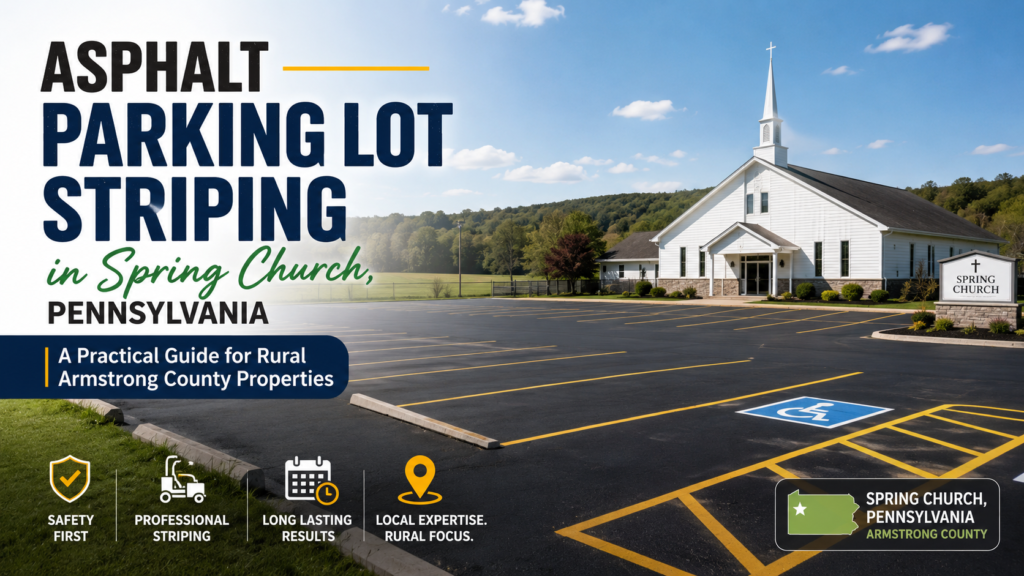
Spring Church, an unincorporated community in Armstrong County, Pennsylvania along Route 56 in the Kiskiminetas River valley, may not bring to mind the kind of large commercial parking lots found in major metropolitan areas, but the businesses, churches, agricultural operations, and small commercial properties throughout this rural Western Pennsylvania community still depend on properly marked parking areas. Whether the surface in question is a small congregation Asphalt Parking Lot Striping Spring Church lot, a farm supply business lot, a rural medical office, or a community center, parking lot striping plays the same essential safety, accessibility, and organizational role here as it does anywhere else adapted to the practical realities of a small rural community.
What Parking Lot Striping Provides
Parking lot striping is the application of durable, traffic-grade paint markings to a paved surface to organize vehicle and pedestrian movement, define parking spaces, and meet legal accessibility requirements. For Spring Church area property owners, a complete striping scope addresses:
- Standard parking stall lines: White lines marking individual parking spaces at appropriate width (typically 9 feet) and depth (18 to 20 feet) for passenger vehicles, applied at an angle suited to the lot configuration perpendicular, angled, or parallel depending on available space and traffic flow.
- ADA accessible parking spaces: Blue and white markings designating accessible spaces, with the access aisle, correct dimensions, and the International Symbol of Accessibility. Even small rural businesses and churches open to the public are subject to ADA requirements if they have any public parking.
- Fire lane markings: Red curb or pavement markings designating fire apparatus access routes where required by Armstrong County fire codes for commercial and institutional properties.
- Directional arrows and traffic flow markings: Particularly useful in smaller lots where traffic patterns are not intuitively obvious, directional arrows help visitors navigate efficiently and safely.
- Loading and designated use areas: For farm supply and agricultural businesses common in the Spring Church area, marked loading zones and equipment areas help organize traffic flow around heavier vehicle activity.
Why Small Rural Lots Still Need Professional Striping
It can be tempting for owners of small commercial properties in a rural community like Spring Church to view striping as an unnecessary formality reserved for larger urban or suburban commercial centers. This view overlooks the genuine functions that striping serves regardless of lot size:
- Safety and liability: Even a 10-space parking lot benefits from clearly defined spaces that prevent random, disorganized parking that can create blind spots, restrict emergency vehicle access, or create pedestrian hazards. Property owners carry liability exposure for injuries that occur on their parking surfaces, and well-organized, clearly marked lots reduce this risk.
- Legal ADA compliance: The Americans with Disabilities Act applies to any commercial or public-serving property regardless of size or location. A church, a small medical office, or a farm supply store in rural Armstrong County is subject to the same ADA accessible parking requirements as a large suburban shopping center the requirements simply scale to a smaller number of total spaces, with most small lots requiring just one accessible, van-accessible space.
- First impressions: For rural businesses competing for customer attention, a clean, well-marked parking lot signals professionalism and care that customers notice, even subconsciously, when they arrive at a property.
ADA Requirements for Small Lots in Armstrong County
The ADA accessible parking space requirements scale directly with total lot size. A parking facility with 1 to 25 total spaces which describes most Spring Church area commercial and institutional properties requires a minimum of one accessible space, and that space must be van-accessible (meaning it requires either an 8-foot-wide space with an 8-foot access aisle, or an 11-foot-wide space with a 5-foot access aisle). The accessible space and its access aisle must not exceed a 2 percent slope in any direction, and the space must be marked with both pavement striping and a vertical sign bearing the International Symbol of Accessibility.
Many smaller rural properties in Pennsylvania were paved or repaved before current ADA standards were fully understood or enforced, and property owners may not realize their parking facility is non-compliant until an inspection, complaint, or insurance review brings the issue to attention. Reviewing accessible parking compliance is a worthwhile step for any Spring Church property owner planning a restriping or resurfacing project.
The Effect of Western Pennsylvania Climate on Pavement Markings
Armstrong County experiences the full range of Pennsylvania seasonal weather hot, humid summers, significant annual precipitation, and winters with regular freeze-thaw cycling and snow accumulation. These conditions affect how quickly parking lot markings deteriorate:
- Snow plowing: Rural and small commercial lots in Spring Church are typically plowed by the property owner or a local snow removal contractor. Plow blades in direct contact with the pavement surface a common practice on smaller lots without raised reflective markers to guide blade height physically abrade painted lines each winter.
- Freeze-thaw cycling: The same mechanical action that damages asphalt surfaces also loosens the bond between paint and pavement, accelerating peeling and fading.
- UV exposure: Summer sun gradually bleaches traffic paint, causing white lines to gray and yellow markings to lighten over successive seasons.
Given these factors, most parking lot striping in Armstrong County requires refreshing every 2 to 3 years for typical use, with lots that receive heavy winter plowing potentially needing more frequent touch-up.
Striping After Sealcoating or Resurfacing
A practical point that is sometimes overlooked by rural property owners is that any sealcoating or resurfacing project on a striped parking lot automatically covers the existing markings, requiring complete restriping afterward. When planning pavement maintenance for a Spring Church property, restriping should be budgeted and scheduled as part of the same project as sealcoating or resurfacing, ideally performed within 24 hours of sealcoat curing to prevent vehicles from establishing informal parking patterns before the new markings are applied.
The Striping Process for Small Commercial Lots
Professional striping of a small to mid-size parking lot in the Spring Church area follows a straightforward process: the surface is swept and cleaned of debris and loose material to ensure good paint adhesion; the layout is planned to maximize usable spaces while meeting ADA and fire code requirements; guide marks are established with chalk lines or tape; traffic-grade paint is applied using a professional striping machine for consistent line width and thickness; and stencils are used for symbols, accessible space markings, and any required text. For most rural lots, the entire process can be completed in a single day, with paint typically dry to light traffic within 30 to 60 minutes under good weather conditions.
Conclusion
Parking lot striping in Spring Church and the surrounding Armstrong County rural community serves the same essential safety, legal compliance, and presentation functions as it does in larger urban settings, scaled appropriately to smaller lot sizes. Property owners whether managing a church, a farm supply business, a medical office, or any other commercial or institutional property benefit from understanding ADA requirements applicable to their lot, recognizing how Western Pennsylvania winters accelerate marking deterioration, and planning restriping as a coordinated part of broader pavement maintenance.